


Buzzer Social Media Platform FZCO
Sheikh Rashid Tower, Floor 04,
Premises 407-FZF 131,
Dubai, United Arab Emirates
+971 58 296 9368




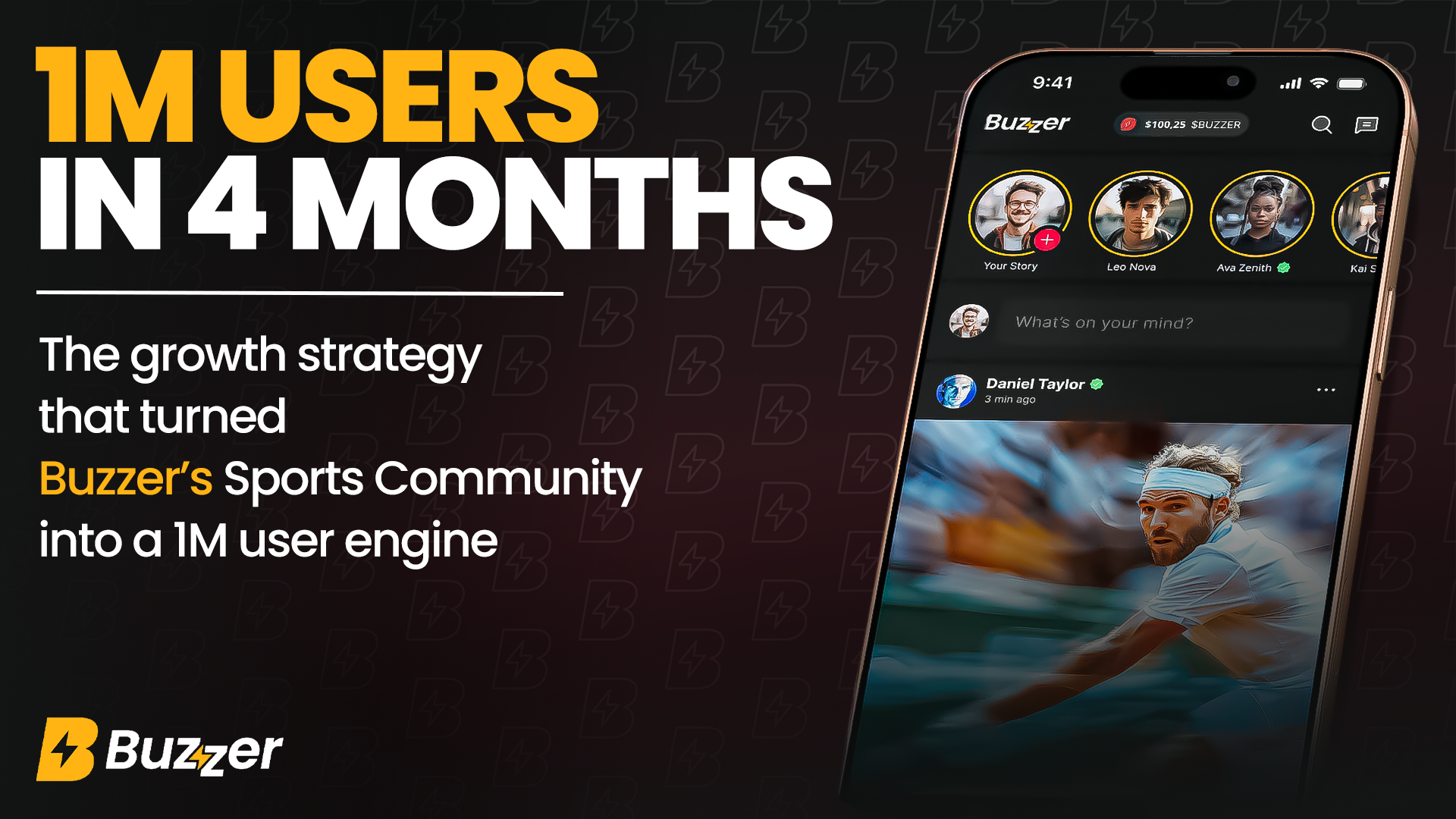
In just 4 months, we scaled a mobile platform from early traction to over 1,000,000 users, while continuously lowering acquisition costs and increasing the share of organic growth.
Here’s how we did it - and what it means for scaling further.
At the start, the challenges were typical but critical. The product had low brand awareness, limited discoverability, and no dominant acquisition channel. Growth depended on constant experimentation, while paid acquisition remained expensive and unpredictable.
This is where most products stall.
But these constraints also pointed to a larger opportunity: instead of optimizing individual channels, we focused on designing a system where growth could sustain itself.
Rather than asking “how do we get more users?”, we asked a different question:
How do we turn every user into a distribution channel?
That shift changed everything.
We built a modular growth engine combining incentives, community behavior, influencer distribution, and discoverability mechanics. Each part wasn’t meant to work in isolation, but to reinforce the others - creating a loop where growth feeds more growth.
In the early stage, the priority wasn’t efficiency - it was momentum. We introduced simple incentive mechanics tied to referrals and content visibility, encouraging users to bring others onto the platform. At the same time, we ran controlled experiments across small communities to understand behavior patterns.
This initial volume wasn’t perfect, but it served a purpose. It generated the signals needed for algorithms - app stores, social platforms, and recommendation systems - to start paying attention.
Once that signal was established, the dynamic shifted.
Instead of pushing growth through the brand, users began pulling it themselves. Content creation moved into the hands of the community, while influencers and niche groups became natural distribution nodes. Growth started to spread in a compounding way, no longer tied directly to spend.
As momentum increased, we focused on discoverability. By aligning app store presence with real user intent - through keyword strategy, tailored listings, and coordinated signals - we turned visibility into a long-term acquisition channel. At that point, growth was no longer linear. It started to compound.
Finally, once scale was achieved, the focus shifted to stability. Systems were introduced to manage influencer relationships, improve content quality, and ensure compliance. This allowed the platform to grow without breaking under its own weight.
Within four months, the platform surpassed 1,000,000 users. Daily growth peaked at 57,000 users, before stabilizing between 8,000 and 20,000 per day in the final phase.
At the same time, acquisition costs declined to approximately $0.085 per install, while nearly half of all growth came from organic sources. The rest was driven largely by influencers and community-led distribution, not traditional paid campaigns.
Perhaps most importantly, growth became increasingly independent of direct spend.
This case shows that when properly designed, growth can function as a system rather than a series of disconnected tactics. Early volume can act as a catalyst for algorithmic visibility. Communities can outperform paid channels.
And once discoverability is unlocked, growth begins to compound rather than scale linearly.
Because the system is modular, it can be adapted across different products and markets - from mobile apps to marketplaces and community-driven platforms.
More importantly, it becomes more efficient over time.
With the growth engine validated, the next phase is straightforward: expand into new markets, deepen community layers, and introduce monetization mechanisms on top of an already scalable distribution system.
What matters is building a system that can reach the next million - and the million after that - more efficiently each time.
That’s what turns growth into something investable.




.png)
.png)
%20(1).png)

%20(1).png)
.avif)
.png)


