


Buzzer Social Media Platform FZCO
Sheikh Rashid Tower, Floor 04,
Premises 407-FZF 131,
Dubai, United Arab Emirates
+971 58 296 9368



TL;DR: To run football tryouts well, decide first how many spots you're filling and what you're looking for, then open registration with a cap and a deadline. Check The FA's approach rules before inviting players registered elsewhere. Run the session as warm-up, small-sided games and a full match, scored by more than one coach on the same sheet. Tell every player the outcome. Palm City FC's 2026 tour shows how far a fair, open process can reach.
Most clubs think the hard part of running football tryouts is picking the best players. Get enough talent through the gate and the rest sorts itself out.
It rarely does. Tryouts go wrong long before anyone kicks a ball. Too many sign-ups and nowhere near enough coaches. A player invited from another club without the right notice. Three coaches scoring on gut feel, with no shared idea of what "good" means for a left back.
And the players who don't make it go home with no idea why. Some of them will tell their friends.
So this guide covers the whole process: what to decide first, how to get the right players to sign up, the FA rules you can't skip, how to structure the session and score it fairly, and how to deliver the bad news well. Whether you call them tryouts or trials, football or soccer, the steps are the same.
Decide how many spots you're filling, in which positions and age groups, what you'll judge players on, and who will do the judging. Then pick a date, a venue and a maximum number of players your coaches can actually watch properly. Every other decision follows from those.
Start with the gaps in your squad, not the tryout. If you need a goalkeeper and two centre backs, say so in the invitation. You'll attract the right players and spend less time watching ten strikers chase one ball.
Then agree your criteria before the day. Pick four or five things you'll score every player on, such as technique, decision-making, work rate, positional understanding and attitude, and make sure every coach means the same thing by each one.
Finally, set your cap. A rough rule is that one coach can't judge more than a handful of players at once with any accuracy, so count your evaluators and work backwards.
Open registration online with a clear date, time, venue, age groups, positions needed, any fee and a deadline, and cap the numbers. Ask for position, age, previous club and contact details on the form. Then share it where players actually look: local football groups, schools, your club channels and platforms where players are already searching for trials.
The cap matters more than it seems. A tryout with a fixed number of places looks organised and gives you a waitlist to pull from if someone drops out. An open "just turn up" call gives you no idea who's coming or how many coaches you need.
And confirm every sign-up. A confirmation email with the address, kick-off time, what to bring and what to wear cuts no-shows and the questions you'd otherwise answer one message at a time.

Yes, but in England you must follow The FA's rules on approaching players first. A club wanting to approach a player registered with another club has to send a written approach notice to that club's secretary or chair before talking to the player, and there are limits on how many players you can approach at one club at a time.
In the 2023-24 version of the rules (Rules C90 to C98), the approach notice went by email to the player's club, a club could approach up to two players at another club at any one time, and it then had to wait 28 days before approaching another player there. Check the current season's handbook with your County FA, because the detail changes.
Other associations have their own versions. In Scotland, for example, Scottish Women's Football requires a player attending an open trial to have written permission from the club holding their registration.
So add one question to your registration form: "Are you currently registered with a club?" It takes ten seconds to answer and can save you a disciplinary charge.
Run it in four blocks: check-in and a short warm-up, a few technical drills, small-sided games, then a full match. Drills show you technique, small-sided games show decisions under pressure, and the match shows how players read the game in their real position. Most of your judging should happen in the last two blocks.
Here's a simple running order for a two-hour session:
If you're working with under-18s, have your Club Welfare Officer or another trained adult on site, and keep parents informed about timings and pick-up.
Use more than one coach, one shared scoring sheet and the same criteria for everyone. A fair tryout judges every player on the same things, by more than one person, in a way you could explain to them afterwards.
A one-to-five scale on four or five criteria is enough:

Have each coach score on their own, then compare at the end. Where two coaches disagree by more than a point, talk it through before you decide.
And write a one-line note for every player you score. It makes your decisions easier to defend, and it gives you something useful to say to the players who don't make it.
Personally, promptly and with one useful piece of feedback. Most players can handle a no. What sticks with them is never hearing back at all.
Set a date in your wrap-up and keep it. Send a short, kind message to everyone who wasn't selected, with one specific thing from your notes they can work on. If you have a development squad or another tryout later in the season, tell them about it.
For younger players, speak to the parent as well. And never announce the squad in a group chat before you've told the players who missed out. Players remember how a club treated them long after they've forgotten the result.
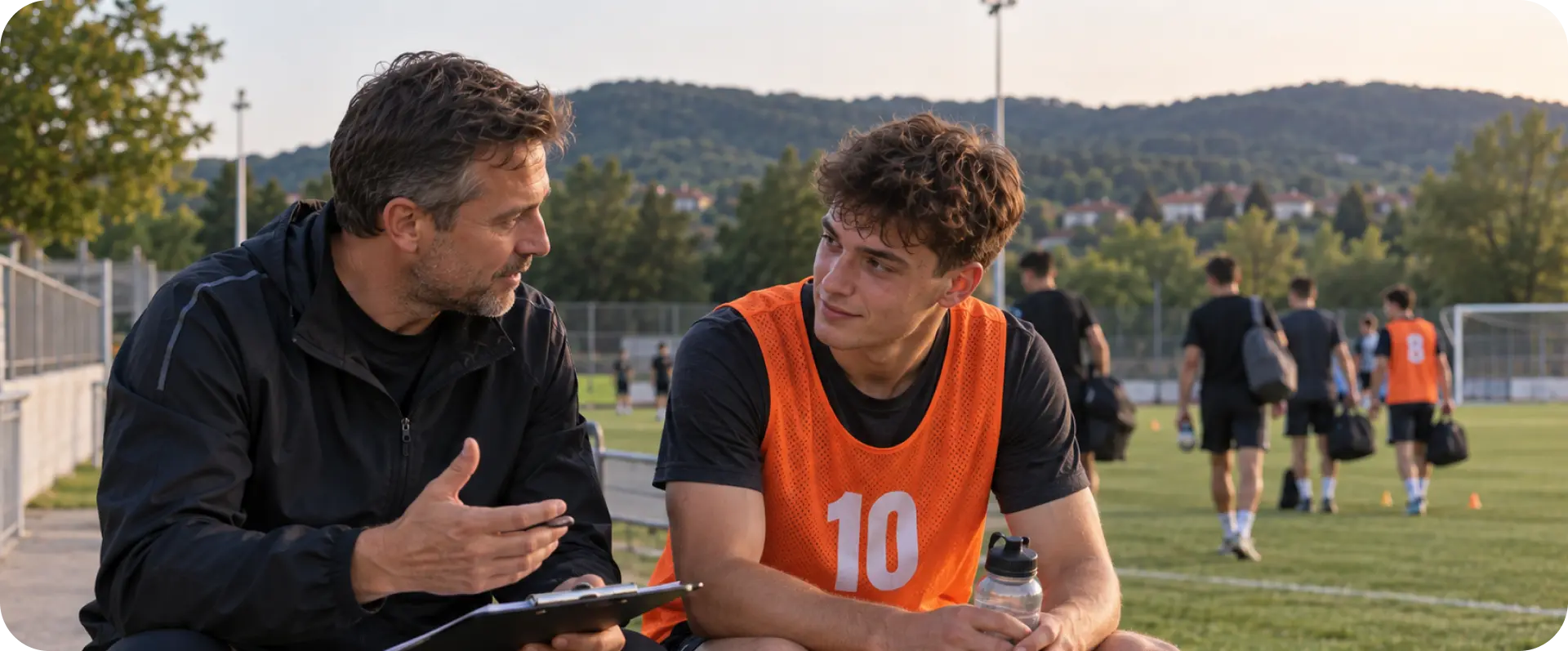
In 2026, UAE club Palm City FC ran open tryouts across 8 European countries, with Buzzer as the tour's General Sponsor. It's a useful model because it got the basics above right at a much bigger scale.
Every player applied directly through the Buzzer app. No agents, no agency fees. Each country session was capped at 50 players, who played 11v11 matches in front of licensed professional coaches, and at least one player per country was promised a fully covered trip to Dubai.
Then came Sarajevo. Fifty players turned up across June 23 and 24, and two were selected: Stefan Radaković, a left winger from Prijedor, and Daris Kablić, a central defensive midfielder from Ključ. The coaching staff made the call, with club founder Soheil Var there in person for the final selection.
Most clubs won't run a tour across Europe. But the lessons travel: one place to apply, a fixed cap, a real match format, clear criteria and a decision made by the people who'll coach the players.
Three things to take away:
When you're ready to open your next tryout to more players, get your club verified with the Organization Badge and take applications and registrations through Buzzer. To keep an eye on applications from your phone, download the Buzzer app.
Around two hours works for most clubs: a short warm-up, some technical drills, small-sided games and a full match. That gives coaches enough time to see each player in game situations without tiring everyone out.
As many as your coaches can watch properly. Count your evaluators, decide how many players each can follow, and set a cap. Palm City FC capped each session on its 2026 European tour at 50 players for 11v11 matches.
In England, yes. The FA's rules require a written approach notice to the player's current club before you approach them, with limits on how many players you can approach at one club. Check the current season's rules with your County FA.
Agree four or five criteria in advance, such as technique, decision-making, work rate, positional understanding and attitude. Score every player on the same scale, and judge mostly in small-sided games and full matches.
Personally and on the date you promised, with one specific piece of feedback from your notes. For younger players, include the parent, and tell unsuccessful players before you announce the squad.


